Frequently Asked Questions
-
Building science is the study of how a home performs as a system — how heat moves, how air flows, how moisture behaves inside your walls. Most homes are built without much thought to any of it. High-performance homes are designed around it from day one.
-
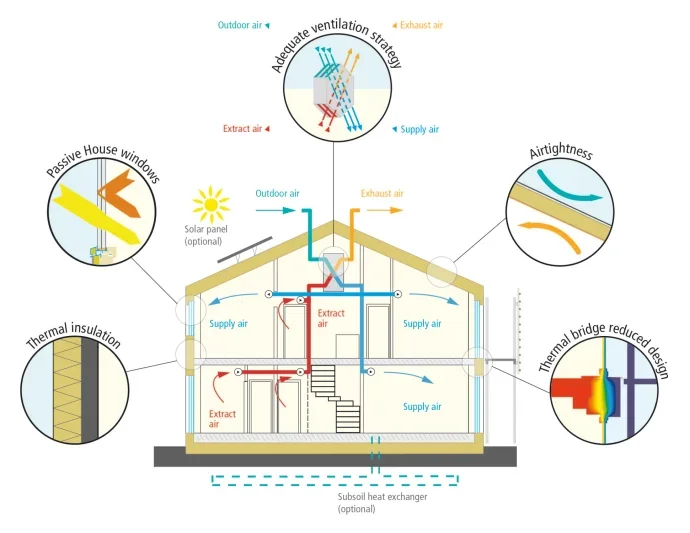
A Passive House is built to a certified standard that prioritizes airtightness, superior insulation, and controlled ventilation. The result is a home that stays consistently comfortable year-round, uses a fraction of the energy of a conventional home, and has dramatically better indoor air quality. It's not a style — it's a performance standard.
-
The upfront cost is higher — usually 5–15% depending on the project. But the math changes quickly when you factor in energy savings, lower maintenance, better health outcomes, and long-term durability. Our clients think of it as building a home they'll never have to apologize for.
-
Completely. Building science is about how a home performs, not how it looks. You can have any architectural style, layout, or finish level — the performance standard works underneath all of it.
-
Passive House certification is the gold standard for high-performance building. It means the builder has been trained in and tested on the specific science behind airtightness, insulation, and ventilation — not just claiming to build "green."
-
Minnesota temperatures can swing 60 degrees or more within a single day. These dramatic fluctuations put constant stress on a home's building envelope — the walls, roof, and foundation that separate conditioned interior space from the outside. A high-performance building envelope is designed to manage heat, air, and moisture under these conditions, maintaining consistent interior comfort regardless of what's happening outside.
-
Everything. Conventional homes either seal too tight and trap pollutants, or leak too much and lose conditioned air. High-performance homes use mechanical ventilation systems that continuously bring in fresh filtered air while retaining heat — so the air you breathe is always clean, without wasting energy.
-
It almost always is — in some form. High-performance building isn't all or nothing. Whether you're starting from scratch, renovating, or just looking to make targeted improvements, there are meaningful upgrades that can make your home more comfortable, healthier, and less expensive to run. Passive House certification is the most rigorous version of this approach, but better performance is possible at every scale. A building science consultation is the best place to figure out what makes sense for your specific project.
-
About the same as a conventional build. The difference is in the planning — high-performance homes require more detail upfront, which can reduce surprises and delays during construction.
-
High-performance building isn't all or nothing, and improving an existing home is often the more environmentally sustainable choice than building new. Every new build carries an embodied carbon cost — the energy and materials that go into construction itself. Renovating and upgrading what already exists reduces that footprint significantly, while still delivering meaningful improvements in comfort, health, and efficiency. Passive House certification is the most rigorous version of this approach, but better performance is possible at every scale and every budget.